A few months ago, before the warmth came back to these hills, we did something that, to anyone passing, looks like an act of harm. We cut the olive trees back. Hard.
We took away whole branches that had done nothing wrong, opened the heart of each tree to the light, and left them barer, smaller, almost wounded against the winter sky. We do this every year. And every year, a part of us still hesitates before the first cut.
Because pruning is an act of faith, not of force. You take away so that what remains can grow stronger.
You reduce the tree now, this season, so that in the years to come it can give its best: light reaching every leaf, air moving freely through the branches, the strength of the whole plant gathered into fewer places.
You cut back to make room for an abundance you will not see for a long time. A farmer who prunes well is not really thinking about this year. He is thinking about a tree his children will harvest.

And the olive asks for patience like nothing else we grow. You cut in winter, and then you wait.
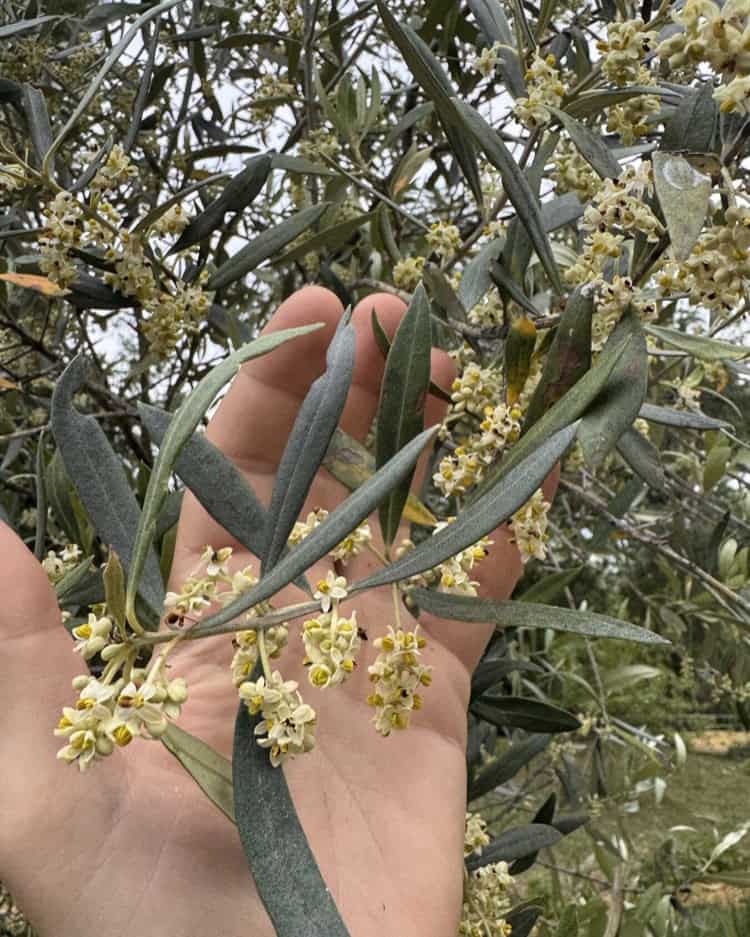
The tree wakes slowly, puts out new wood, and only much later, only if the years are kind, does all that restraint come back to you as flower. Tiny, cream and green, thousands of them on every branch.
Most will fall. A few will set, and harden, and turn from green to purple, and become the olives we carry to the mill in October. Reduce, and wait, and one day there is more. That is the whole grammar of the grove, and it is written in years, not in weeks.
Right now, in June, you can read the result of an older patience. The trees we cut back in winters past are covered in flower, so small that most people walk straight by without seeing them.
It is the most fragile and hopeful thing in the whole grove. And it is still only a promise. Nothing is owed to us yet.
Because everything here hangs on the thread of time, and that thread feels thinner with every passing year.
Last night the sky reminded us how thin that thread has become. A great storm broke over Montalcino in the dark, and we lay awake listening to the rain and the wind, every olive grower on these hills holding the same quiet fear, that the young flowers were being torn from the branches before they ever had the chance to set. This morning we walk the rows slowly, looking up, and we wait to see what the night has left us.
A single cold night can burn the young flowers before they ever set. Ten minutes of hail can strip a tree of an entire harvest. A hot wind at the wrong moment, weeks without rain, one violent storm in the days before picking, and a whole year of cutting and waiting comes to nothing.
We have learned not to count the oil before it is in the tin. The weather we once trusted has become a stranger, and the olive, which has outlived empires, now lives season to season, like the rest of us.
Maybe that is what the olive teaches better than any other tree. You do your part, the cut, the wait, the long quiet attention, and then you hand the rest to the sky.
You control the pruning. You do not control the harvest. There is a strange kind of peace in finally learning the difference.
If you would like to stand in the grove and feel all of this for yourself, we open it to a few guests each autumn, when the nets go down under the trees and the frantoio runs from before dawn. You can pick the olives that years of pruning made possible, follow them to the mill, and taste the oil while it is still warm. Two small groups, October 8 to 11 and October 15 to 18, 2026.
If the year is kind to us, the oil will be extraordinary!