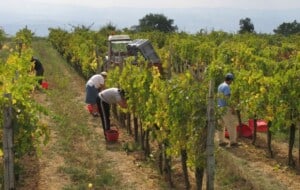
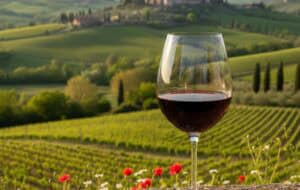
There are two wines that serious wine lovers argue about more than any others in Italy. Barolo, born from Nebbiolo in the cold hills of Piedmont, tannic and austere, a wine that asks for your patience before it gives you anything back. And Brunello, born from Sangiovese in the warm clay and galestro of Montalcino, deeper, more generous, but equally uncompromising. Two wines that don’t try to please. They try to tell the truth about the place where they grow.
The argument about which is greater misses the point entirely. They are not rivals. They are two answers to the same Italian obsession: taking a difficult grape, planting it in one specific place, and don’t move it anywhere else for centuries. To understand one without the other is like reading half a sentence. And the only way to read the full sentence is to live both places, in the same journey, without rushing.

There are perhaps four or five wines in the world that history recognised as great before the market had a chance to decide. Barolo and Brunello are two of them, and they are both Italian. This alone should be enough to make you want to understand them better. The fact that they are so different from each other, born from different grapes in different landscapes with different obsessions, makes the question of how to approach them together one of the most interesting in the world of wine.
Barolo is a wine of roots. The Nebbiolo grape grown in the Langhe hills of Piedmont is a terroir-sensitive variety: move it two kilometres and the wine changes completely. The limestone and clay of Barolo village produces wines of elegance and perfume. The compact Helvetian soils of Serralunga produce something harder, more mineral, built to last decades. You taste them side by side and suddenly the geography makes sense in a way no book ever quite manages to explain. The system of MGA, the official mapping of Barolo’s individual vineyards, exists precisely because these differences are not subtle, they are fundamental. The geology speaks louder than the winemaker.
Brunello is a wine of memory. The disciplinare of Brunello di Montalcino imposes the longest ageing requirements in Italy, and the great old bottles of Biondi Santi demonstrate that a Brunello can cross a century without losing itself. This is not a wine built for immediate pleasure. It is built for permanence, for the idea that what you plant and tend today will still be speaking clearly in fthe long term. The families of Montalcino have built their reputations around this patience, generation after generation, in a way that feels less like a business decision and more like a declaration of faith.
Between these two worlds stands the Apennine mountain range, the spine of Italy. On one side the Langhe, precise and cold, vineyards mapped to the metre, a culture that has turned the differences between hillsides into an almost scientific discipline. On the other side Tuscany, warmer, more generous in its light, where the land rolls rather than cuts and the wine is measured not in parcels but in decades. The mountains do not separate these two Italies: they define them against each other, and the crossing is the moment when you understand that the distance between Barolo and Brunello is not just geographical but civilisational.

The streets of Alba in November belong to the locals, the air carries woodsmoke and, if you are lucky, the first scents of White Truffle. The Langhe hills stretch bare and beautiful in every direction, the vines stripped of their leaves, the slopes catching the low autumn light in a way that makes the geology almost visible to the naked eye. Stay here, among family estates that have been reading this land for generations, and you begin to understand what roots really means.
Then you drive the Apennines along a panoramic connection between two worlds. It’s a change of air and rhythm and language. By the time you arrive in Montalcino in an early evening, climbing the hill into the old town as the last light fades over the Val d’Orcia, something has shifted. You are in a different Italy, one that measures time differently.
Montalcino sits at 564 metres, surrounded by vineyards on every slope. In November the harvest is over, the cellars are full of new wine fermenting quietly in the dark, and the town has a particular stillness. The wines, the estates, the people: nothing here is like Barolo, and yet the same refusal to compromise runs through all of them, the same conviction that great wine is not only made, it is waited for.
By the end of the journey the original question, Barolo or Brunello, feels not just wrong but slightly embarrassing. These are not competing products. They are two chapters of the same long story about what it means to believe in a place so completely that you build your life around it. You think to drink wines but you are actually sipping living culture.
If you want to make this journey, we are doing it this November, from the 1st to the 7th, with a small group of wine lovers. We will be your expert guides for the entire week. All the details are on the tour page.